Gloriously Bad at This: Why the Worst Posters on the Internet Are Winning
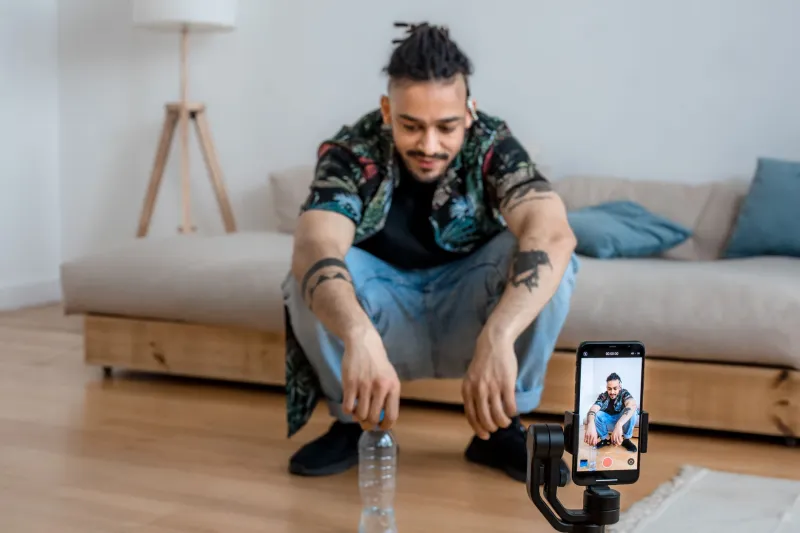
There's a creator on TikTok who posts exclusively between midnight and 4am. Her thumbnails look like they were made in MS Paint during a power outage. Her editing cuts mid-sentence, sometimes mid-word. Her follower count, by every metric that's supposed to matter, should be somewhere around zero. Instead, she has hundreds of thousands of people who show up for every single video like they're waiting for a friend to text back.
This isn't an anomaly anymore. It's a pattern.
Across platforms, a loose and completely uncoordinated movement of creators is quietly dismantling the influencer playbook—not through rebellion exactly, but through a kind of magnificent indifference. They're not gaming algorithms. They're barely acknowledging algorithms exist. And somehow, that's become the most magnetic thing you can do online right now.
The Playbook Nobody Is Following
If you've spent any time in the creator space, you know the rules. Post consistently. Optimize your posting window. Hook viewers in the first three seconds. Use trending audio. Keep your aesthetic cohesive. Engage with comments within the first hour. The list is exhaustive, data-backed, and repeated endlessly in YouTube tutorials with thumbnails of people pointing at things.
The accidental influencers—though calling them accidental undersells what's actually happening—ignore all of it. Not selectively. Wholesale.
Posting schedules are nonexistent or chaotic. One video goes up on a Tuesday afternoon, the next on a Saturday at 2am, the one after that three weeks later with no explanation. Aesthetics shift without warning. A creator who spent six months making moody, desaturated cooking content suddenly uploads a brightly lit rant filmed in a parking lot. The through-line isn't visual. It's something harder to define and, crucially, harder to fake.
What "Bad" Actually Signals
Here's the thing about choppy editing and off-hours uploads: they function as proof. Proof that nobody is optimizing you. That there's no brand manager behind the curtain, no content calendar on a whiteboard, no analytics dashboard being obsessively refreshed.
In an environment where audiences have developed a near-preternatural ability to detect performance, messiness reads as evidence of realness. A video that looks like it was filmed in one take, uploaded immediately, and posted without a second thought carries a kind of credibility that a polished, strategically timed drop simply cannot replicate.
This isn't new as a concept—authenticity has been the buzzword of the decade—but the execution has shifted. Early authenticity content was still fundamentally strategic. Creators were performing relatability, which is its own kind of polish. What's different now is that audiences are parsing a finer distinction: the difference between someone who seems like they don't care about metrics and someone who demonstrably, provably does not.
The bad posting schedule isn't an aesthetic choice. It's evidence.
The Devotion Economy
Follower counts are a crude instrument. What the accidental influencers tend to generate instead is something closer to a devotion economy—smaller, intensely engaged communities that behave less like a passive audience and more like a group of people who feel personally invested in a stranger's life.
Comment sections on these accounts read differently. Less "love this!" and more actual conversation. People tagging their friends not because the content is shareable in a viral sense, but because it reminded them of something specific about a specific person they know. The parasocial relationship, usually a one-way mirror, starts to feel porous.
There's a guy who makes videos about restoring old furniture in his garage in rural Ohio. He films everything on what appears to be a phone from 2019. He's never used a trending sound. His longest video is forty-seven minutes of him sanding a cabinet. He has a comment section that functions like a neighborhood—people who've been there for years, who reference old videos, who ask about the dog that appeared once in 2022.
That's not an audience. That's a community built entirely on the absence of strategy.
The Algorithm Doesn't Know What to Do With This
Platforms are built around signals. Watch time, replays, shares, saves, comments, follows. The algorithm is a pattern-recognition machine, and it's very good at identifying content that behaves like content is supposed to behave.
Creators who post at weird hours with inconsistent frequency generate strange data. They don't spike cleanly. Their growth curves look wrong. And yet, the engagement quality—the depth of interaction, the loyalty signals—is often exceptional.
What's interesting is that some of these creators end up getting pushed by the algorithm anyway, not because they cracked it, but because the devotion of their existing audience creates engagement signals strong enough to override the weirdness of everything else. The algorithm, eventually, follows the humans.
This is almost poetic. The system designed to reward optimization gets circumvented by people who opted out of optimization entirely.
The Sustainability Question
It's worth asking whether this is actually a strategy or just a description of what happens when someone who isn't trying to be an influencer accidentally becomes one.
Probably both, and the line between them is getting blurry. Some creators are absolutely conscious of the anti-strategy strategy—they understand that the appearance of not caring is valuable, and they're curating that appearance carefully. Others genuinely don't care, and that genuine indifference is exactly what people are responding to.
The sustainability issue is real, though. Monetization is harder when you're not playing the optimization game. Brand deals typically want reach and engagement metrics that look a certain way. The creators who build through deliberate messiness often struggle to translate their devoted audiences into revenue in conventional ways.
Some of them don't bother trying. They run Patreons or accept direct support from their communities. Others eventually get discovered by brands that are specifically looking for the authenticity signal and are willing to pay for it in unstructured ways. A few just keep posting at 3am indefinitely, seemingly content to exist outside the economy entirely.
What This Actually Says About Us
The rise of the accidental influencer isn't really about content strategy. It's about what audiences have learned to want after years of being sold to by people who got very good at seeming real.
We got good at spotting the performance. And once you can see it, you can't unsee it. The ring light, the practiced laugh, the comment reply that's warm but just vague enough to scale—it all starts to feel like a costume. So when someone shows up who clearly hasn't thought about any of that, who posts when they feel like it and edits like they don't own a tutorial subscription, it cuts through in a way that nothing polished can.
Being bad at social media, it turns out, is one of the most human things you can be on it. And right now, human is the scarcest resource online.